Mallard (Anas
platyrhynchos)
 |
| Left: Female and male Mallards |
Description:
The mallard is a type of duck native to North America,
Europe, Asia, and North Africa and introduced to Australia and New
Zealand. The mallard is a wild ancestor to almost all varieties of
domesticated ducks. The male (drakes) and females (hens) exhibit sexual
dimorphism with the male usually having a dark green head with a white stripe
on its neck and a yellow beak with black nostrils. The female is a more uniform
light to medium brown color with a more orange beak. Despite their dimorphism,
both sexes have a distinct purple stripe of wings outlined with a white border
that is visible during flight.
Habitat and Diet:
Mallards are largely generalist species that can live in
both salt and fresh water areas. They can live anywhere from the arctic tundra
to subtropical areas such as Mexico. They prefer an area with a water depth
that does not exceed 1 meter and can range from wetlands, to a small pond, to
estuaries. Mallards are also largely migratory and fly from their homes in
North America, Northern Europe, and Asia to subtropical regions for the winter.
A mallard’s diet consists mostly of aquatic vegetation, small insects, and
crustaceans, but their diet consists mostly of plant material. Depending on
their environment, they can adapt their eating habits accordingly. For example,
there are accounts of mallards eating frogs. Mallards are considered “dabbling”
ducks (displayed on video) which means they do not dive far underwater for their food, but rather
dip only a few feet below the surface to scavenge for food.
 |
Mallards usually form pairs and breed in October and
November. The males catch the attention of females with the color of their head
and by using mating calls. The females also participate by making suggestive
movements and calling back to drakes that they are interested in mating with. Although
mating commences in late fall, the eggs are not laid until early spring when
the female lays half her bodyweight in eggs. After each mating season there are
drakes that have been left out of the mating period and resort to pecking and
weakening hens and then take turns copulating with the hen.
Mallards in Seattle:
Mallards are a prevalent species in the Seattle area and can
be found on and near the University of Washington campus. A stroll past the
fountain is almost a guarantee at spotting a few mallards with their newly born
chicks. Also, anywhere where the campus meets Lake Washington or Union Bay
there are sure to be mallards wading near the edge of the water where aquatic
plants are abundant. One such place is the Union Bay Natural Area just south of
the UW soccer fields. This recovered wetland is home to a variety of waterfowl
including lots of mallards. In addition to the Union Bay Natural Area, the
Arboretum is another ideal place in close proximity to campus that is home to
many mallards. Mallards are not hard to spot in a city such as Seattle where
water and wetlands are plentiful. Just keep an eye out next time you are by the
water and the chances of seeing a mallard are high.
Mating for shovelers begins in December when drakes put on
courtship displays, flaunting their feathers and singing to the hens. The
shovelers then form pairs and mate just before their spring migration. By late
May, the shovelers reach their breeding grounds (sometimes the same as the year
before) and begin preparation for nesting. The males become very territorial
and defend the females while they locate materials and begin construction of a
nest to house their eggs. The nests are constructed a good distance away from
the waterfront in large grassy areas. After the nest is complete, the female
lays an egg a day until she has a clutch of about 8-12 eggs. The eggs then go
through an incubation period of about 20-25 days before hatching, at which
point the mother leads the chicks to the water. Following the incubation
period, the father usually abandons the mother and leaves the chicks in her
care.


Hunting:
Herons are a very methodical and patient creature, either seen overhead slowly flapping their enormous wings, or slowly wading or standing in shallows, sometimes as deep as their breast. They typically hunt by wading slowly through the water or standing completely still with their neck crooked back in an S-shape, waiting to quickly strike at any fish or shrimp passing by with its sharp bill. They impale larger fish with their bill. They mostly swallow entire fish whole, and are occasionally known to choke on fish that are too large to fit down their throat. Herons are able to hunt both day and night, with exceptional night vision. While they mostly eat fish, they are not particularly picky about their diet, and are known to eat small amphibians, reptiles, rodents or mammals, and even some birds. According to the Seattle Audobon Society, in the Pacific Northwest, eelgrass beds are one of the most important foraging sites for herons.
Northern Shoveler (Anas clypeata)
 |
| Adult Male Shoveler |
Description:
Northern Shovelers are very distinctive medium sized ducks
that are sexually dimorphic. The males (drakes) are usually very colorful with
an iridescent green head, white chest, a black back with blue patches at the
base of the wings, and rust colored sides. Females (hens) are usually a
gray-brown color with an olive green or yellow bill and brown eyes. Both drakes
and hens have bills that are wider at their tips than at the base resembling a
shovel that is the distinguishing feature of all shovelers.
Habitat:
Shovelers live in open wetland environments, most typically
in marshes or wet grasslands. Their
habitat of choice is mud-bottomed marshes as they are rich in aquatic
invertebrates, their main source of food.
As for their distribution, they are found all over the world, such as
Europe, Africa, and India, and are highly migratory, having very small areas
where it resides year round.
Mating:
 |
| Northern Shoveler migratory regions |
Feeding:
The Northern Shoveler is an omnivore, and its method of
feeding is described as “dabbling”, as it only feeds on the upper surface of
the water, like how Mallard’s feed.
However, they have a very distinctive flat bill that, when Shoveler’s
are dabbling for food, they often swing their bill back and forth,
because it has a little over 100 lamellae, small comb-like structures, on the
edges of its bill that strain food particles, mostly small aquatic
invertebrates and some seeds. Unlike Mallards, they rarely dip their head or
upper body in the water, so they only filter the very top of the water with
their bill. This is a very
different type of feeding from most ducks, and gives them a distinct
competitive advantage, as the food they are filtering for is never rare.
Great Blue Heron (Ardea Herodias)
Being Seattle’s city bird, the Great Blue Heron is an extremely common, large wading bird belonging in the conservation classification of Least Concern. It usually stands between 45 and 54 inches tall (or between 3’9” and 4’6”), with a wingspan of 65.7 to 79.1 inches, and a weight of about 4-7 pounds.

Habitat:
Herons live by shores and open wetlands, both marine and freshwater, including swamps, marshes, and flooded meadows. Due to the heron’s dependence on fish in its diet (although they can eat small rodents and occasionally other birds as well), it can live pretty much anywhere close to bodies of water. They typically nest up in trees, or in large shrubs, with their nests being about three feet in diameter.

While juveniles are not territorial over feeding grounds, adult males defend feeding areas throughout the entire year, and adult females defend feeding areas typically during nesting season. Herons can be found in Seattle all year long, but are also found in such widely diverse area, breeding in North America, Central America, the Caribbean, and the Galapagos.
Mating Behavior:
They have a very distinctive squawk-call, which is heard most often during the mating season. Mating birds nest in colonies, typically of a dozen to several hundred, so although Great Blue Herons are mostly monogamous birds, there are accounts of interbreeding between mate pairs. While we were at the heron rookery at University of Washington for our Natural History class, we observed some heron mating behavior. Two herons was nesting high up in a big leaf maple, while another attempted to swoop in and claim the female for his own, since Great Blue Herons will mate with males other than their own (typically ones with the same or longer plumes). A short tussle occurred between what I assume were the two males, and the attempting heron did not succeed in securing the mate, and flew off. During the tussle the characteristic squawk was heard many times.
In the northern areas, such as around Seattle, eggs are lain as early as April in a clutch size anywhere from two to six, and they are very similar in size to a chicken egg. The incubation period is 27 days, and the time spent sitting on the egg is split up between the male and female, while the one not sitting is foraging and feeding. After the incubation period, the eggs hatch over a period of a couple days. After about 8 weeks, some of the herons will leave the nest and fly for the first time. However, the mortality rates are very high during the first year of the young heron’s life, at 69% according to the EPA, most likely due to their being “vulnerable to predation, disease, inclement weather, starvation, and falls from the nest (both accidental and sibling-caused)” (EPA species profile)
Hunting:
 |
| Adult Blue Heron |
Great Blue Herons have special feathers that, when brushed with their foot, causes powder to fall on caught fish that collects the oil and slime in a clump and allows the herons to brush it off with a foot. The powder is also rubbed on themselves in order to repel unwanted slime and oils from dirty water.
Western
Gull (Larus
occidentalis)
Breeding:
 |
| Adult Western Gull (Source: allaboutbirds.org) |
Description:
The
Western Gull is native to the Pacific coast of North America, from British
Columbia to Baja California. It is a well-known species, recognized by its
distinctive white head, chest and underbelly. It has grey wings with black tips
and its feet and bill are yellow. It is often confused with the Slaty-backed
Gull, Glaucous-winged Gull, and especially the Yellow-footed Gull, which only differs in foot color. In fact, the
Western Gull was once believed to be conspecific to the Yellow-footed Gull due
to its highly similar appearance. A full-grown Western Gull is approximately 60
cm long and reaches full plumage after four years. The juvenile plumage is
mottled brown with white and black. The Western Gull typically lives around 15
years, but in some cases may live to be 25 years old.
Habitat and Diet:
This
marine species can be found in pelagic regions throughout the Pacific
coastline. It is found in both salt water and fresh water areas; however, it is
rarely found far from the ocean shoreline. The Western Gull typically nests in
rocky coastal areas, estuaries, and offshore islands. It feeds on fish and
ocean invertebrates (krill, jellyfish, squid), cockles, starfish, snails,
limpets, and the carcasses of sea lions and seals. Western Gulls are opportunistic
feeders, often feeding on human refuse from landfills and human-inhabited
areas. They also scavenge human leftovers from beaches, marinas, parks, and
patios. This sneaky species has been known to steal a fish right out of a
pelican’s beak and even milk from a lactating seal.
 | |
| Distribution of Western Gull (Source: planetofbirds.com) |
 |
| Juvenile Western Gull (Source: nathistoc.bio.uci.edu) |
The Western Gull commonly hybridizes with the
Glaucous-winged Gull. In many cases, hybrid varieties are more common than not,
especially in Washington. These hybridized gulls closely resemble a Thayer’s
Gull, but can be distinguished by a flat head, thicker beak, and larger size.
Western Gulls usually nest within the territory of their colony. Clutches are
comprised of three eggs, which are incubated for one month. The chicks remain
within the territory until they have fledged. There is a high level of chick
mortality in this species. In colonies with more females than males, two
females may form a bonded pair. In this case, the two females take care of a
double-sized brood.
Canada Goose (Branta canadensis):
Description:
Average length: Male 25-45 inches
Average weight: Male: 3-13lbs, Female: 3-11lbs. Both the male and femals Canada Geese have a black neck and head with a broad white patch that stretches across from the throat of the goose to behind its eye. The white patch is often smaller in the female goose. The body of the goose varies from a brownish gray color and gradually gets darker in color as it nears the tail end. The feet, bill and legs are black in color. Native to temperate regions in North America, the Canada Goose is most identifiable by the "honking" call.
Habitat and Diet:
Canada Geese live in marshes and habitats along the water. Canada Geese favor grassy areas for two main reasons: they are able to digest the grass and the wide fields of grass provide the geese with an advantage in seeking possible predators that are approaching their young. Their diets vary depending on the different seasons. In the winter and fall, the geese feed on agricultural grains, seeds, and berries, particularly blueberries. In the summer and spring seasons, they feed on sedges and grasses, in particular, eelgrass and skunk cabbage leaves.
Breeding:
Canada Geese migrate and fly in flocks. Canada Geese have strong family bonds and return to their birth place to nest, females tend to lay between 2-8 creamy white colored eggs with an incubation period of 25-28 days. Nests are located in a slightly elevated mound near the water. The female geese select the nesting site and builds the nest while during incubation period, the female incubates the eggs while the mate protects and guards the nest.
Wood Duck (Aix Sponsa):
Description:
The Wood Duck is medium-sized, three quarters the size of a Mallard Duck. The Wood Duck is the most colorful waterfowl in North America. The male Wood Duck has a brightly colored green crest shaped droopy head, chestnut colored breast, and green and yellow colored body. This Duck's feathers display intricate patterns. The male Wood Duck has red eyes, the female Wood Duck is less colorful with a grayish brown colored body with a brown and white spotted chest. The males are called drakes and the females are called hens.
Habitat and Diet:
The Wood Duck is a bird that is rarely found on the water, rather, wooded wetlands. They prefer slow-moving waters that are aligned with trees, more specifically, deciduous trees. The Wood Duck's diet varies from insects, seeds, fruits, and arthropods.Their diet is based on the availability of resources. When aquatic foods are scarce the Wood Duck makes its way to dry land and feeds on acorns and other nuts, however, 80% of the Wood Duck's diet are plant materials. Some examples of food eaten are: acorns, soybeans, blackberries, wild cherries, smartweed, water primrose, duckweed, snails, caterpillars, panic grass, beetles, and flies.
 |
| Adult Male Hooded Merganser (Source: birdweb.org) |
 |
| Adult Female Hooded Merganser (Source: birdweb.org) |
 |
| Distribution of Hooded Mergansers in WA (Source: birdweb.org) |
Hooded Merganser (Lophodytes cucullatus):
Description:
The Hooded Merganser is a small to medium sized duck that
migrates a relatively short distance. It is the only member of Genus Lophodytes. The Hooded Merganser has a unique, fan-like crest on the
back of its head, which can be expanded or contracted. The species is sexually
dimorphic in that the males have a large white patch on their black crest. The
male’s head and body are also black with white stripes on the body, and the
wings are light brown. The female is slightly smaller and mottled grey, light
brown, and white. Both females and males have a sawbill (long and narrow) and a
white underbelly. Average length is 18.1 inches for males and 17 inches for
females. Average weight is 1.6 lbs for males and 1.5 for females.
Habitat and Diet:
This
species is restricted to North America, and is most abundant near the Great
Lakes, throughout the Northwest, Alaska, and Southwestern Canada. During the
winter, they prefer forested wetlands, brackish estuaries, and tidal creeks.
They nest in tree cavities near shallow waters. The Hooded Merganser has a more
diverse diet than other mergansers. Primary food sources for this species
include small fish, crayfish, insects, and crustaceans. They detect their prey
by sight and hunt by diving and swimming in fresh water.
Breeding:
Females are ready to reproduce after two years. Before pairs form in winter, colonies display a process of dramatic courtship displays. The male leaves the female soon after the eggs have been laid. Clutches usually contain 10-12 eggs, and the female is completely responsible for incubation. After the chicks hatch they leave the nest with their mother after one day. The chicks are capable of hunting for themselves right away and leave their mother after five weeks. The chicks are not yet fledged when they leave their mother.
Females are ready to reproduce after two years. Before pairs form in winter, colonies display a process of dramatic courtship displays. The male leaves the female soon after the eggs have been laid. Clutches usually contain 10-12 eggs, and the female is completely responsible for incubation. After the chicks hatch they leave the nest with their mother after one day. The chicks are capable of hunting for themselves right away and leave their mother after five weeks. The chicks are not yet fledged when they leave their mother.
Canada Goose (Branta canadensis):
Description:
Average length: Male 25-45 inches
Average weight: Male: 3-13lbs, Female: 3-11lbs. Both the male and femals Canada Geese have a black neck and head with a broad white patch that stretches across from the throat of the goose to behind its eye. The white patch is often smaller in the female goose. The body of the goose varies from a brownish gray color and gradually gets darker in color as it nears the tail end. The feet, bill and legs are black in color. Native to temperate regions in North America, the Canada Goose is most identifiable by the "honking" call.
 |
| Two Adult Canada Geese |
Habitat and Diet:
Canada Geese live in marshes and habitats along the water. Canada Geese favor grassy areas for two main reasons: they are able to digest the grass and the wide fields of grass provide the geese with an advantage in seeking possible predators that are approaching their young. Their diets vary depending on the different seasons. In the winter and fall, the geese feed on agricultural grains, seeds, and berries, particularly blueberries. In the summer and spring seasons, they feed on sedges and grasses, in particular, eelgrass and skunk cabbage leaves.
 |
| Distribution of Canada Geese in North America (Source: sdakotabirds.com) |
Canada Geese migrate and fly in flocks. Canada Geese have strong family bonds and return to their birth place to nest, females tend to lay between 2-8 creamy white colored eggs with an incubation period of 25-28 days. Nests are located in a slightly elevated mound near the water. The female geese select the nesting site and builds the nest while during incubation period, the female incubates the eggs while the mate protects and guards the nest.
 |
| Canada Geese and their chicks. (Source: Ducks.org) |
Description:
 |
| Male Wood Duck (Breeding) (Source: naturescapes.net) |
 |
| Female Wood Duck (Source: athistoc.bio.uci.edu) |
The Wood Duck is a bird that is rarely found on the water, rather, wooded wetlands. They prefer slow-moving waters that are aligned with trees, more specifically, deciduous trees. The Wood Duck's diet varies from insects, seeds, fruits, and arthropods.Their diet is based on the availability of resources. When aquatic foods are scarce the Wood Duck makes its way to dry land and feeds on acorns and other nuts, however, 80% of the Wood Duck's diet are plant materials. Some examples of food eaten are: acorns, soybeans, blackberries, wild cherries, smartweed, water primrose, duckweed, snails, caterpillars, panic grass, beetles, and flies.
Breeding:
The Wood Ducks breed across mainly central and eastern United States, along the Pacific coast from British Columbia to California, and southeastern Canada. However, the highest breeding densities are located in the Mississippi Alluvial valley. An average of 12 white eggs are laid in each nest. The female Wood Duck nests in tree cavities and when ducklings are ready to hatch they are alert and have a full coat of down, and after only a day old, the ducklings jump out of the nests that are located up to 290 feet in height just over the water and follow their mother's call.
Bufflehead (Bucephala albeola)
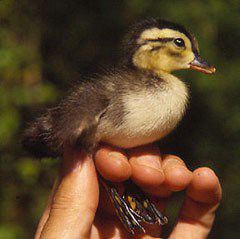 |
| Wood Duck Duckling (Source: hiltonpond.org) |
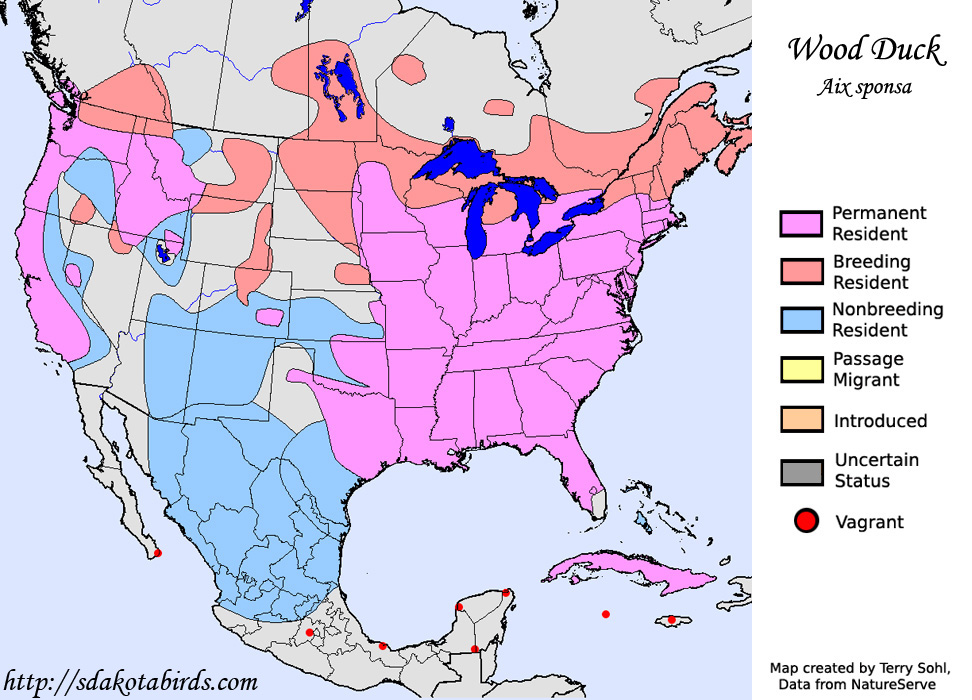 |
| Distribution of Wood Ducks in North America (Source: sdakotabirds.com) |
Description:
 |
| Male Bufflehead |
The
Bufflehead is the smallest diving duck in North America, coming in at between
12 and 16 inches in length, and topping out at about a pound and a half (the
males larger than the females). Adult
males have a white body with a black back, an iridescent green head much like
the mallard, but with a large white spot on the back of the head, and a small
gray beak. The females have a gray side
with a black back, and a black head as well with a small white spot on the side
just below and behind the eye. The males have the ability to alter the size of their head by making the feathers on the back of their head upright to embody a larger head to attract the females. Both
males and females have a peculiarly rounded head, somewhat resembling a
buffalo, which is how they got their name.
Habitat:
Buffleheads
primarily live next to lakes or ponds, and reside in forested areas with aspens
or poplars. They
typically spend their time in the winter in shallow saltwater, but also in
lakes and rivers. When the Bufflehead migrate north after the winter season they are most commonly found in the taiga biomes (aka Boreal Forests) of Northern Canada and also Alaska. The bird is not in any
danger of becoming extinct, but habitat degradation is the biggest threat due
to their dependence on forest habitat and limited coastal habitat.
Mating Behavior:
 |
| Female Bufflehead |
Buffleheads
are only seen in the Seattle area during the wintertime, as they migrate north
to Canada during summer mating season.
They are one of the few monogamous ducks, and often maintain the same
mate for multiple years. They typically
nest in Northern Flicker woodpecker cavities (sometimes Pileated Woodpecker cavities), and lay about 9 eggs, with a 30-day incubation
period. After almost two months, the
ducklings become capable of flight. Buffleheads also
return to the same breeding areas for repeated years, and are monogamous.
Diet:
Buffleheads
are a diving bird and typically forage underwater. In freshwater, they feed mostly on insects,
and in saltwater they eat crustaceans and mollusks. In both habitats they feed on aquatic plants
as well. Bufflehead also travel in small flocks and when the flock is out foraging for food, one Bufflehead will be on duty looking out for predators while the others feed.
Cinnamon Teal (Anas cyanoptera)
Cinnamon Teal (Anas cyanoptera)
 |
| Male Cinnamon Teal in breeding plumage (source: birdweb.org) |
Description:
This mid-sized duck looks like a mix between a Blue-winged
Teal and a Northern Shoveler. Similar to the Shoveler, it has a long, wide
bill, which distinguishes it from the Blue-winged variety. The Cinnamon Teal is
most widely known for its red eyes and the bright cinnamon color plumage that
occurs in males during breeding season. They also have a light blue patch with
white on the upper wings and a black and white tail. The eclipse (basic) male
plumage is mottled gray-brown with a rusty sheen. The female looks similar to
the male in eclipse plumage, with mottled gray-brown plumage. One
distinguishing trait between males and females is the color of the bill; the
male exhibits an all black bill, while the female has a white area near the
base of the bill. It cen be very difficult to distinguish the female Cinnamon
Teal from the female Blue-winged Teal and the female Green-winged Teal. The
female Blue-winged Teal has a more patterned body and face, in addition to a shorter
bill. The female Green-winged Teal exhibits darker brown plumage and lacks the
blue patch on her wing.
 |
| Female Cinnamon Teal (source: birdweb.org) |
Habitat and Diet:
The Cinnamon Teal lives in shallow, freshwater wetlands.
They eat seeds and aquatic vegetation, insects, snails, and zooplankton. To
obtain food, teals swim forward with their heads underwater and filter mud
through their bill in a process known as dabbling. The nest is built on a site that the female
selects, usually close to water and well concealed.
Breeding:
Like most dabblers, teals form pairs before their arrival at the breeding grounds. Each female lays a clutch of 9-10 eggs and incubates them for 21-25 days. The male is not involved in this process, but remains on the breeding grounds and guards the female. The young fledge at about 7 weeks, but obtain their own food shortly after hatching. One unusual behavior observed in teals is the presence of the male with the female and her brood after hatching.
Like most dabblers, teals form pairs before their arrival at the breeding grounds. Each female lays a clutch of 9-10 eggs and incubates them for 21-25 days. The male is not involved in this process, but remains on the breeding grounds and guards the female. The young fledge at about 7 weeks, but obtain their own food shortly after hatching. One unusual behavior observed in teals is the presence of the male with the female and her brood after hatching.

What about buffleheads? I've seen those all over UBNA.
ReplyDeleteYou're right! Thanks, Tessa. We will add a species account for Buffleheads.
ReplyDelete